
Road Force vs Standard Balancing: What the Difference Actually Is
Two different measurements, two different problems. Knowing which one your car needs saves you from paying for a balance that was never going to work.
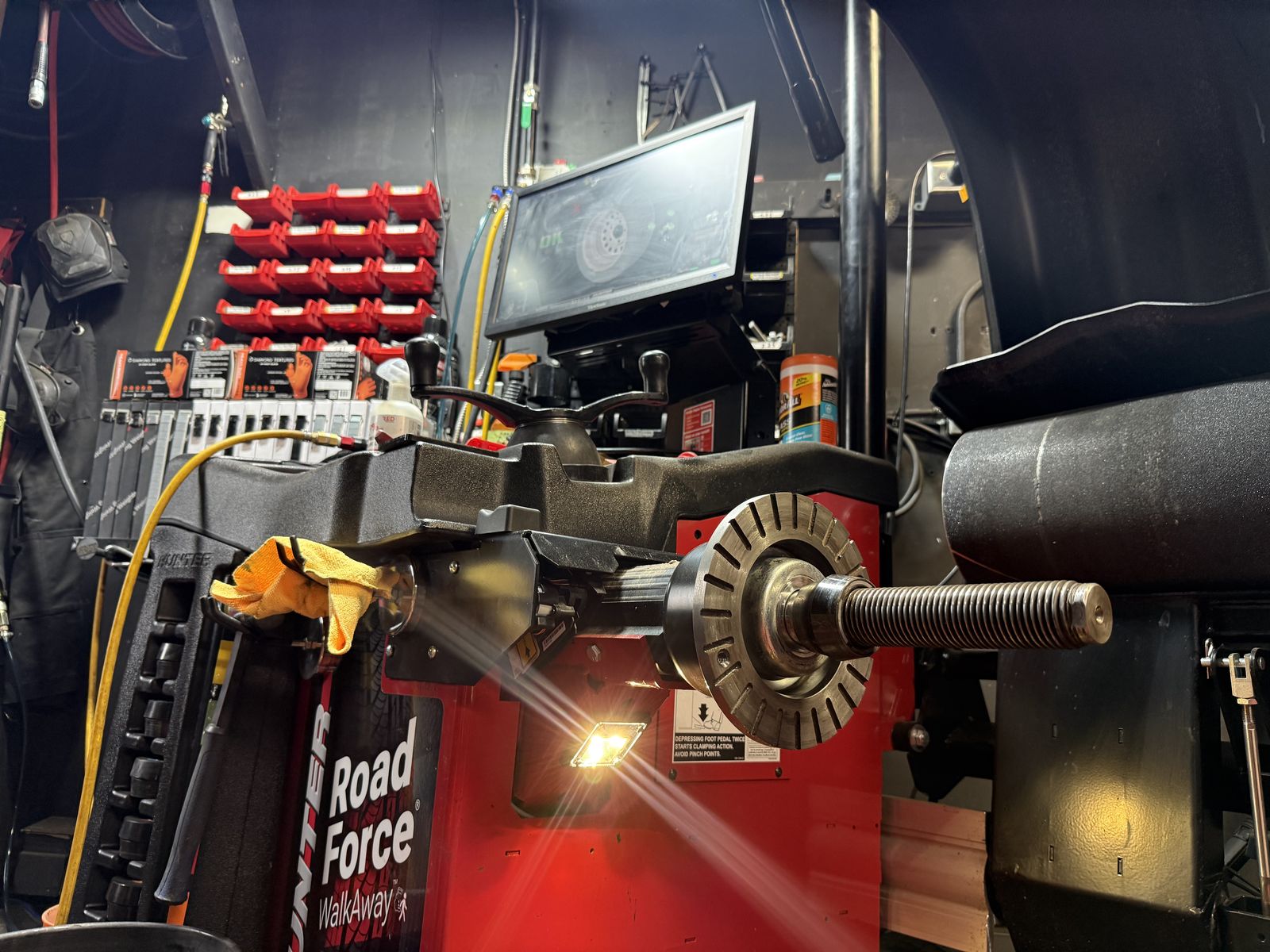
Both services end with your wheels spinning true. They get there by measuring completely different things, and that is why one sometimes works when the other has already failed.
Standard balancing: a weight problem
Put a wheel on a balancer, spin it, and the machine detects where the mass is uneven. Add counterweights opposite the heavy spots. Done.
This solves imbalance, which is genuinely the most common cause of vibration. A tire loses a weight on a pothole, the assembly goes out of balance, the wheel shakes at highway speed, a rebalance fixes it.
What the machine never asks is whether the tire is round.
Road force balancing: a shape problem
A road force machine adds a loaded roller that presses against the tread while the wheel spins, simulating the weight of the car. It then measures how much force the tire pushes back with through a full rotation.
A perfectly uniform tire pushes back with the same force at every point. A real one often does not.
The gap between the highest and lowest reading is the road force variation. That number tells you something weight measurement physically cannot: whether the tire deforms evenly under load.
Why weight cannot fix shape
This is the part worth understanding, because it explains every repeat balance that did not work.
Imagine a tire with a slightly stiffer section in one part of the sidewall. Spin it with no load and it is perfectly balanced, because the mass is even. Put the car's weight on it and that stiff section does not compress as much as the rest. Once per rotation the hub gets pushed up slightly.
That is a vibration. It is also perfectly balanced by weight.
You can add counterweights all day and the pulse stays, because you are correcting a mass problem that does not exist while ignoring a stiffness problem that does.
What each one actually fixes
Standard balancing fixes: uneven weight distribution from manufacturing tolerance, a thrown weight, mud or ice packed in a rim, a repair patch adding mass on one side.
Road force balancing fixes or identifies: tires out of round under load, uneven sidewall stiffness, bent or out of round rims, and assemblies that can be improved by rotating the tire on the rim to cancel the two high points against each other.
Note the word identifies. Road force does not repair a defective tire. It proves the tire is defective, which is what you need for a warranty claim, and it tells you not to keep paying to rebalance something that will never come right.
The practical rule
Start with a standard balance. It is the right first step and it solves most vibrations.
If the vibration survives a correct standard balance, stop repeating it. The measurement has already told you the answer is somewhere else, and road force is how you find out where without guessing.
A note on new tires
If you are buying a full set, especially in a larger diameter or a low profile, road force on the install is worth considering up front. Catching an out of round tire on day one means it goes back as a warranty claim before it has worn, rather than being discovered in March after you have driven on it all winter.
We handle manufacturer warranty claims for tires we sell, and a road force reading is the kind of evidence those claims are decided on.
Frequently asked questions
Is a standard balance good enough?
For most tires on most cars, yes. It becomes insufficient when the tire itself is out of round or has an uneven stiff spot, because no amount of counterweight corrects for that.
Does road force balancing cost more?
It takes a more capable machine, so it is a separate service. See our pricing page for current rates.
Can I tell which one I need?
If the car rode fine before and a fresh balance fixed it, standard was enough. If a balance has already been done and the vibration is still there, the standard measurement has already told you it cannot solve this one.
Related
Book your visit at PitStop & Go
300 Wilsey Road #1, Fredericton, New Brunswick E3B 5J1 · (506) 248-6006