
Are All Terrain Tires Good for Winter?
A chunky tread block is not what makes a tire work in winter. The compound is, and most all terrain tires use a summer compound.
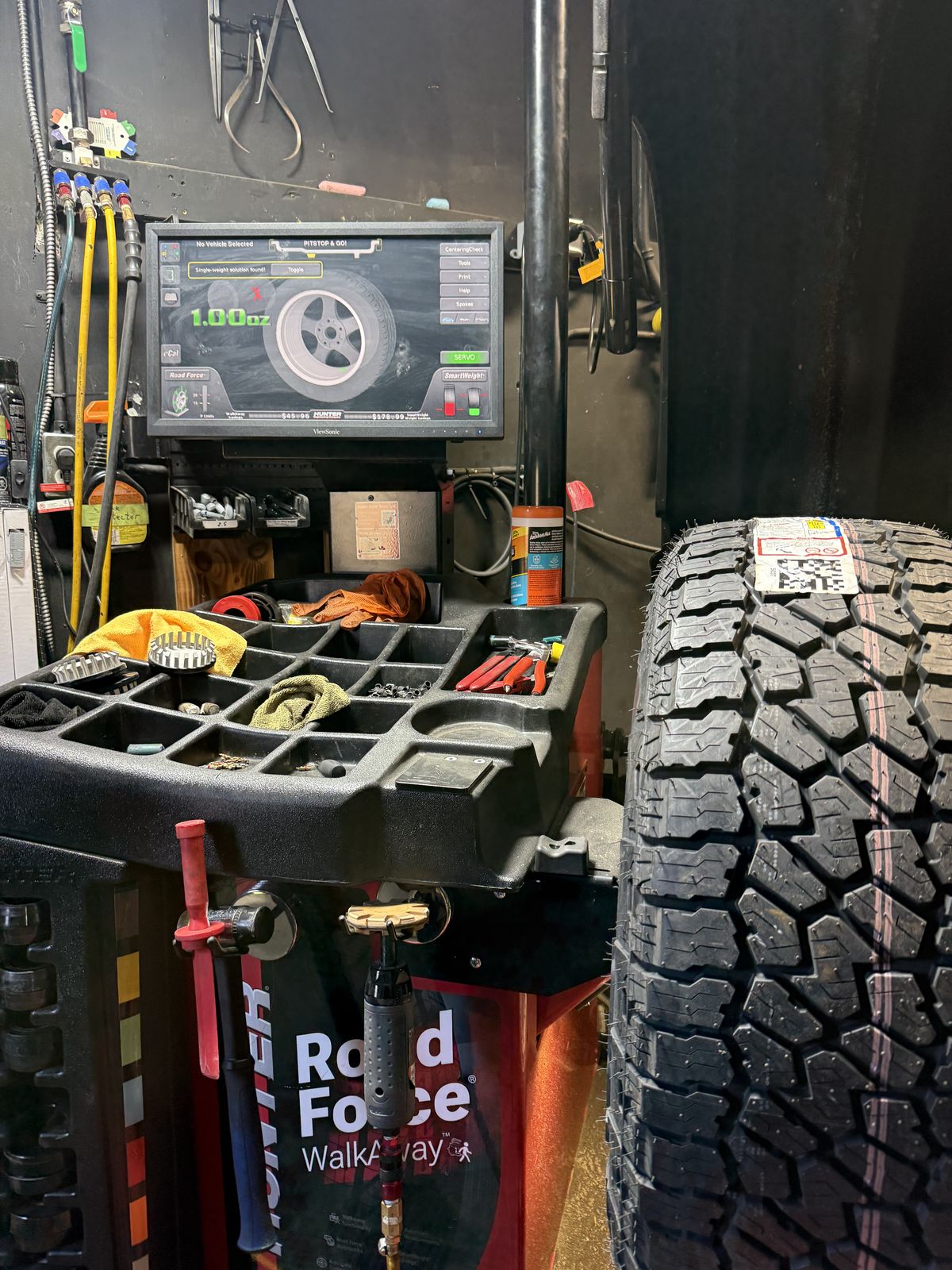
All terrain tires look like they should be good in snow. Big blocks, deep voids, aggressive shoulders. For a lot of truck and SUV owners in New Brunswick that look is the whole reason to buy them.
The looks are misleading, and here is why.
Tread pattern is the smaller half
What makes a tire work in winter is mostly the compound, not the pattern.
Below roughly seven degrees Celsius, a standard tire compound stiffens. A stiff tire cannot conform to the microscopic texture of the road surface, and that conformity is where grip comes from. This happens on bare dry pavement before snow is part of the conversation.
Winter compound is formulated to stay pliable in the cold. That is the core technology.
Most all terrain tires use a compound built for a different job: resisting cuts and chips from gravel and rock, and lasting on hot pavement. Those requirements push in the opposite direction from cold flexibility.
So you get a tire with winter-looking tread and summer-behaving rubber.
Where all terrain tires genuinely help
Deep unpacked snow. Open tread voids and large blocks do dig and clear better than a closed all season pattern. On an unplowed road with fresh snow, an all terrain is meaningfully better than a highway all season.
Mud, gravel, and getting out of a ditch. Which is what they are actually designed for.
Ground clearance applications. Often fitted with more sidewall, which helps on rough surfaces.
Where they fall down
Ice. This is the big one. Ice grip comes from compound flexibility and from siping, the fine slits across tread blocks that create biting edges. Most all terrain tires have limited siping and a cold-stiff compound. On a New Brunswick freezing rain morning this is where the difference becomes obvious and unpleasant.
Packed snow. The hard polished snow of a well used road behaves much more like ice than like fresh powder. Same problem.
Cold dry pavement. Braking on a minus 15 morning, an all terrain is working with stiffened rubber. This affects every stop you make all winter, not just the dramatic ones.
The exception worth knowing
A growing number of all terrain tires do carry the three peak mountain snowflake. Those have passed the same snow traction test as a winter tire.
They are a real category and they are genuinely better in winter than a standard all terrain. They typically use a more cold tolerant compound and much more siping while keeping the rugged construction.
They are still a compromise. A snowflake rated all terrain is better than an all season and not as good on ice as a dedicated winter tire. But for a truck owner who needs the durability year round and faces mixed conditions, it is a sensible middle.
Check the sidewall. If the snowflake is not there, the tire has passed no snow test, whatever the tread looks like.
Four wheel drive does not change this
Worth stating plainly, because it comes up every winter.
Four wheel drive and all wheel drive help you accelerate. They put power to more wheels so you are less likely to spin and get stuck.
They do nothing for braking and nothing for cornering. Those depend entirely on the grip between four tires and the road. A four wheel drive truck on cold-stiff all terrains stops no better than a two wheel drive car on the same tires, and it is heavier, so in practice it often stops worse.
The common New Brunswick winter incident is a truck that got up to speed easily and then could not stop or turn. That is a tire problem wearing a drivetrain disguise.
The practical recommendation
Mostly highway and town, winter is your concern: dedicated winter tires, even on a truck. The difference on ice is large.
Mixed use, job sites, gravel, and you need one set: a snowflake rated all terrain is the right compromise. Check for the symbol, and check the load index meets your truck's spec.
Serious off road use and you also face real winter: two sets. An all terrain for the work season, a winter set for the cold months.
If you tell us what the truck does and where it goes, we will size something that actually fits the use. Load index matters more on trucks than on anything else, and it is the specification most often downgraded by accident.
Frequently asked questions
Do all terrain tires have the snowflake symbol?
Some do, most do not. Only the ones carrying the three peak mountain snowflake have passed a snow traction test. Check the sidewall rather than assuming.
Are all terrain tires better than all seasons in snow?
Usually slightly, in deep unpacked snow where the open tread can dig. On ice and packed snow the difference is small, because both use compounds that stiffen in the cold.
Can I run all terrains year round in New Brunswick?
You can, and many people do. If your winter driving includes ice or unplowed roads, a dedicated winter tire is a clear step up.
Related
Book your visit at PitStop & Go
300 Wilsey Road #1, Fredericton, New Brunswick E3B 5J1 · (506) 248-6006