
Why Is My Tire Losing Air With No Visible Puncture?
The first thing we check is the valve stem, because a leaking stem looks like nothing at all. After that it is a very small puncture, sidewall damage, or a leak where the tire meets the rim, often caused by corrosion or debris trapped in the bead.
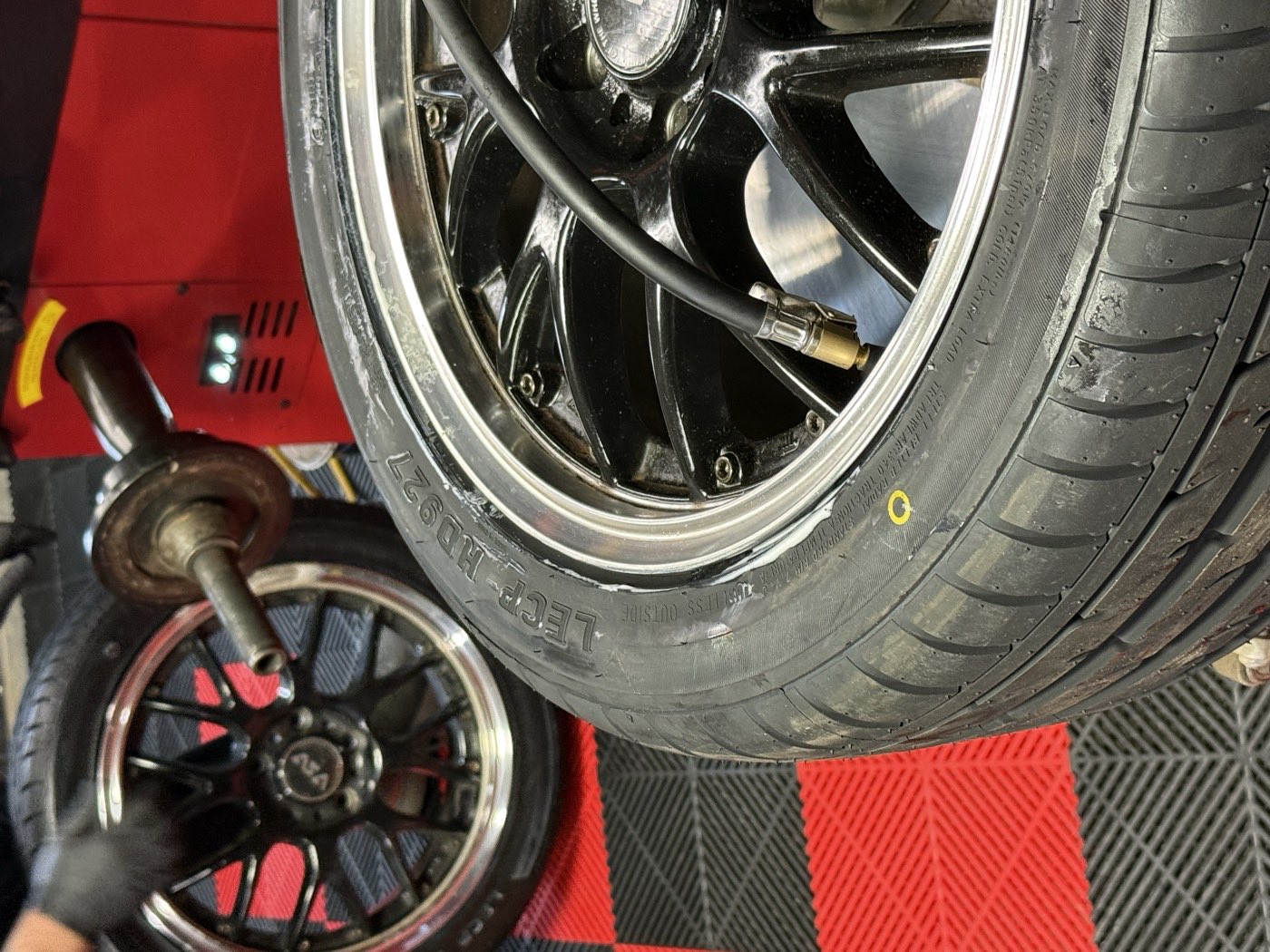
The first thing we check is the valve stem, because a leaking stem looks like nothing at all. After that it is a very small puncture, sidewall damage, or a leak where the tire meets the rim, often caused by corrosion or debris trapped in the bead.
A tire that goes down over a week with nothing visible in the tread is one of the more common things we see, and it is almost always one of four things.
What causes a tire to lose air with no puncture?
Four causes, and we work through them in a set order because that order finds it fastest. The valve stem comes first, then a very small puncture somewhere in the tread, then damage to the sidewall, then the bead seal where the tire meets the rim. Each one is invisible from where you park the car.
When a tire is slowly losing air and there is no obvious puncture, our first go-to is the valve stem. You push the stem around to see whether it leaks. If it does not, we start checking for really small leaks on the tire, another puncture or something tiny like that. If we cannot find anything, we go to the sidewall and check for damage there. Then we check the gap between the rim and the tire. Sometimes there is corrosion inside the rim, or debris trapped between the tire and the rim, and that causes a leak. We take the tire off, put bead sealer on it, and mount it back on. Sometimes that is a temporary fix though, and depending on the case you might need a new tire or a new rim.
The four suspects, in the order we check them
| Cause | What it looks like |
|---|---|
| Valve stem | Nothing visible. It leaks when the stem is moved |
| Very small puncture | A pinhole, often invisible until the tire is off |
| Sidewall damage | Sometimes visible, sometimes only from the inside |
| Bead leak | Air escaping where the tire seals against the rim |
What is a bead leak?
The bead is where the tire seals against the rim, and that seal needs both surfaces clean and smooth to hold air. Corrosion inside the rim, or grit and debris trapped in there, breaks the seal and lets air past slowly. It is common on older rims and on any wheel that has been through several New Brunswick winters.
How it gets fixed
- The tire comes off the rim
- Both sealing surfaces get cleaned up
- Bead sealer goes on
- The tire is remounted, inflated, and leak tested
That works in most cases. Where it does not, the corrosion has gone far enough that the rim itself is the problem, and no sealer holds against a surface that is breaking down. We will tell you which one you have rather than sell you the same fix twice.
Could it just be the cold?
Often, yes, and this is the one that catches most people in the fall. Cold weather pulls pressure out of a correctly inflated tire without any leak being involved, and why your tire pressure light comes on when it gets cold is the full explanation of what is happening and what to do about it.
In cold weather, if it was hot outside and then it got cold overnight, tire pressure drops, and it happens more than people think. Sometimes it drops a little, sometimes a lot. Keep an eye on your tire pressure. This is also the reason we recommend having working TPMS sensors, because in an emergency you know the tire is going flat before you can see it or feel it.
Leak or temperature?
- Temperature: all four tires down by a similar amount, after a cold snap, and they hold after you top them up
- Leak: one tire consistently lower than the others, dropping again within days of being topped up
Set your pressures to the number on the sticker inside your driver's door jamb, not the maximum figure moulded into the tire sidewall. That sidewall number is the tire's ceiling and inflating to it over-inflates nearly every vehicle on the road.
How do you find a slow leak at home?
Check the pressure cold, before driving anywhere, and write the number down. Check it again a few days later. A tire that drops steadily while the other three hold has a leak, and at that point it is worth bringing in rather than topping up every week and hoping it settles.
Tracking it down properly means getting the tire off the rim and inspecting the inner liner, the bead surfaces, and the stem. That is not a driveway job, and a leak you cannot find from outside is usually one that is hiding somewhere you cannot reach.
Why does working TPMS matter for a slow leak?
A slow leak is exactly the failure a tire pressure monitoring system is built to catch. It warns you while the tire is going down rather than after it is flat, and that timing is the whole difference between a repair and a ruined tire. It also matters most in winter, when you are least likely to be checking pressures by hand.
TPMS work here is posted and flat, the diagnostic is $50 pre-tax and waived if you book the repair the same day, and the sensor, relearn, and diagnostic prices are all set out in what the tire pressure light means.
If your pressure light has been on for a while and you have been living with it, that is worth sorting before winter.
Key takeaways
- Valve stem first. It leaks with nothing visible to see.
- Then a tiny puncture, then the sidewall, then the bead seal at the rim.
- Bead leaks come from corrosion and trapped debris, and road salt causes the corrosion.
- Bead sealer fixes most of them, and it can be temporary if the rim is far gone.
- All four tires dropping after a cold snap is temperature, not a leak.
- Working TPMS catches a slow leak before it ruins the tire.
Frequently asked questions
Why does my tire keep losing air but there is no nail? The most common cause is the valve stem, which can leak without any visible damage at all. After that it is a very small puncture, damage to the sidewall, or a leak at the bead where the tire seals against the rim. Corrosion inside the rim and trapped debris both cause bead leaks.
Can a leaking bead be fixed? Often yes. We take the tire off, clean both sealing surfaces, apply bead sealer, and remount it. Be aware it can be a temporary fix depending on how far the corrosion has gone. If the rim is badly corroded or the tire itself is finished, the real answer is a replacement.
Why do my tires lose pressure in cold weather? Air contracts as it cools, so pressure drops with the temperature. A warm day followed by a cold night can pull a noticeable amount out of a correctly inflated tire, and it happens more than people expect. Check your pressures whenever the weather turns sharply colder.
How do I find a slow leak myself? Check your pressure cold, before driving anywhere, and write the number down. Check it again a few days later. If one tire is dropping steadily while the others hold, bring it in. Finding exactly where it leaks means taking the tire off the rim, which is the part worth leaving to a shop.
Frequently asked questions
Why does my tire keep losing air but there is no nail?
The most common cause is the valve stem, which can leak without any visible damage at all. After that it is a very small puncture, damage to the sidewall, or a leak at the bead where the tire seals against the rim. Corrosion inside the rim and trapped debris both cause bead leaks.
Can a leaking bead be fixed?
Often yes. We take the tire off, clean both sealing surfaces, apply bead sealer, and remount it. Be aware it can be a temporary fix depending on how far the corrosion has gone. If the rim is badly corroded or the tire itself is finished, the real answer is a replacement.
Why do my tires lose pressure in cold weather?
Air contracts as it cools, so pressure drops with the temperature. A warm day followed by a cold night can pull a noticeable amount out of a correctly inflated tire, and it happens more than people expect. Check your pressures whenever the weather turns sharply colder.
How do I find a slow leak myself?
Check your pressure cold, before driving anywhere, and write the number down. Check it again a few days later. If one tire is dropping steadily while the others hold, bring it in. Finding exactly where it leaks means taking the tire off the rim, which is the part worth leaving to a shop.
Book your visit at PitStop & Go
300 Wilsey Road #1, Fredericton, New Brunswick E3B 5J1 · (506) 248-6006