
Do You Need 4 Winter Tires or Can You Just Do 2?
You need four. Two winter tires and two all-seasons gives one end of the car more grip than the other, which causes sliding and uneven stopping. On an all-wheel-drive vehicle, mismatched tires also put real strain on the drivetrain. That imbalance is worst in a corner or under hard braking, right when you need grip the most.
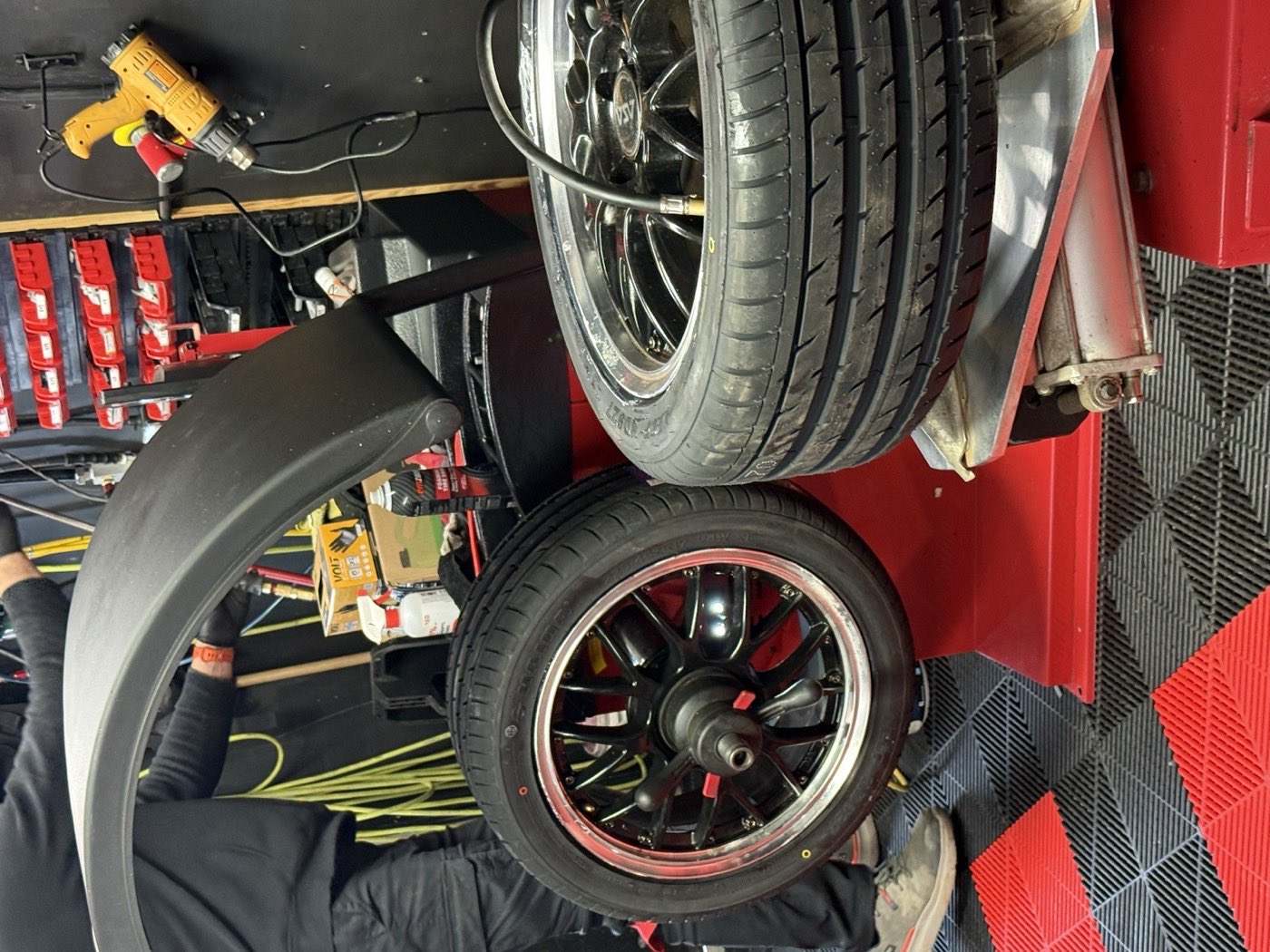
You need four. Two winter tires and two all-seasons gives one end of the car more grip than the other, which causes sliding and uneven stopping. On an all-wheel-drive vehicle, mismatched tires also put real strain on the drivetrain. That imbalance is worst in a corner or under hard braking, right when you need grip the most.
This comes up every single fall, usually as a budget question. It is a fair question with an answer that does not bend.
Why do you need four matching winter tires?
Because grip has to be balanced end to end. Your car is designed around all four tires behaving the same way. Put winter tires on one axle only and you have built a vehicle that grips at one end and slides at the other, which is worse than having no winter tires at all.
When somebody asks us for two winter tires, the first thing we do is ask them to add the other two. If two are winter and two are all-season, we do not recommend it, and we will tell you so at the counter. Either the front or the rear starts sliding and the car ends up in a crash. Stopping becomes uneven. And if you are driving an all-wheel-drive vehicle, you can damage the all-wheel-drive system, because you cannot run different tires on different wheels on those cars. There is a lot that goes with it. You need four winter tires.
What actually happens with two
| Setup | What goes wrong |
|---|---|
| Winters on the front only | The rear loses grip first in a corner. The back end steps out and you are correcting a slide |
| Winters on the rear only | The front loses grip first. You turn the wheel and the car keeps going straight |
| Any 2-and-2 combination | Braking is uneven front to rear, and stopping distance goes up |
| 2-and-2 on all-wheel drive | All of the above, plus drivetrain strain |
If a single damaged tire is really what's driving the two-versus-four question, see whether it can be repaired first.
Neither version of two is the safe version. Front only and rear only fail in different ways, and both fail at the worst possible moment.
Is it worse to put winter tires on the front or the rear?
Both are bad in different ways. Winters on the front only lets the rear break loose in corners, which is how a car spins. Winters on the rear only means the front cannot steer or brake with the rest of the car. There is no correct half-measure here.
Front-only is the more common mistake
Whatever you decide, book the full set through our Fredericton winter tire page.
Most drivers think about winter tires as a traction problem for getting moving, which points them at the drive wheels. But tires do three jobs: accelerating, braking, and turning. Two of those three involve all four corners. A front-wheel-drive car with winters on the front will pull away from a stop beautifully and then fail to stop or turn like the driver expects.
Do all-wheel-drive vehicles need four winter tires?
More than any other vehicle. An all-wheel-drive system continuously compares wheel speeds and distributes power based on the assumption that all four tires are identical in size and grip. Mismatched tires produce different rolling diameters, which the system reads as constant slip.
Why mismatched tires damage an AWD drivetrain
- Different tread depths mean different rolling diameters
- Different rolling diameters mean the axles turn at slightly different speeds, permanently
- The centre differential or coupling absorbs that difference continuously
- Over time that is heat, wear, and eventually failure of an expensive component
This is why a lot of manufacturers specify that all four tires on an all-wheel-drive vehicle be replaced together, even when only one is damaged. Two winter tires and two all-seasons is that same mismatch, made deliberate and left on the car for six months.
What if you cannot afford four winter tires right now?
Then buy four certified all-weather tires instead of two winters and two all-seasons. A matched all-weather set carries the 3PMSF winter certification, keeps grip balanced at all four corners, and runs year round. It is a real compromise. Mixing is not a compromise, it is a hazard.
Better options than mixing, in order
- Four winter tires. Best grip, best stopping, and each set lasts longer because it only runs half the year
- Four all-weather tires. Certified for winter, runs year round, one set to buy
- Four all-seasons and adjusted driving. Not good, but at least the car is balanced
- Two winters and two all-seasons. Do not
Whichever route you take, the posted Fredericton tire change rates price the fitting by vehicle size.
If budget is the constraint, four all-weather tires solves it more honestly than half a winter set does. You spend once instead of twice, and the car behaves the same way at both ends.
Key takeaways
- Four matching winter tires, always. Two is not half as good, it is a different and worse problem.
- Winters on the front only lets the rear slide out. Winters on the rear only kills steering and braking.
- Braking distance goes up whenever only two tires are doing winter-grade work.
- On all-wheel drive, mismatched tires create constant drivetrain strain and can cause real damage.
- If four winter tires are out of reach, four certified all-weather tires beat any 2-and-2 mix.
Frequently asked questions
Can I put winter tires on the front only? You can physically, but you should not. With grip only at the front, the rear of the car loses traction first in a corner and the back end steps out. Braking becomes uneven front to rear. Whether the car is front, rear, or all-wheel drive, the answer is four matching winter tires.
What happens if you mix winter and all-season tires? One axle grips and the other does not. In a corner or a hard stop the low-grip end breaks away first, which is how a controllable situation turns into a spin. Stopping distances go up because only two tires are doing winter-grade work.
Do all-wheel-drive vehicles need four winter tires? Especially. All-wheel drive splits power between axles based on the assumption that all four tires are the same size and grip. Mismatched tires create rolling diameter differences the system has to fight constantly, which strains the drivetrain and can damage it.
Is it cheaper to buy two winter tires now and two later? It is cheaper this month and more expensive over the life of the set, because you end up with two tires wearing at a different rate and a car that is unsafe in the meantime. If budget is the issue, a certified all-weather set of four is a better answer than two winters and two all-seasons.
Frequently asked questions
Can I put winter tires on the front only?
You can physically, but you should not. With grip only at the front, the rear of the car loses traction first in a corner and the back end steps out. Braking becomes uneven front to rear. Whether the car is front, rear, or all-wheel drive, the answer is four matching winter tires.
What happens if you mix winter and all-season tires?
One axle grips and the other does not. In a corner or a hard stop the low-grip end breaks away first, which is how a controllable situation turns into a spin. Stopping distances go up because only two tires are doing winter-grade work.
Do all-wheel-drive vehicles need four winter tires?
Especially. All-wheel drive splits power between axles based on the assumption that all four tires are the same size and grip. Mismatched tires create rolling diameter differences the system has to fight constantly, which strains the drivetrain and can damage it.
Is it cheaper to buy two winter tires now and two later?
It is cheaper this month and more expensive over the life of the set, because you end up with two tires wearing at a different rate and a car that is unsafe in the meantime. If budget is the issue, a certified all-weather set of four is a better answer than two winters and two all-seasons.
Book your visit at PitStop & Go
300 Wilsey Road #1, Fredericton, New Brunswick E3B 5J1 · (506) 248-6006