
Why Do You Need to Re-Torque Wheels After a Tire Change?
Lug nuts can lose clamping force in the first kilometres after a wheel is installed, as the wheel settles against the hub and the metal beds in. A re-torque at around 100 km catches that before it becomes a loose wheel. It takes minutes and it is free.
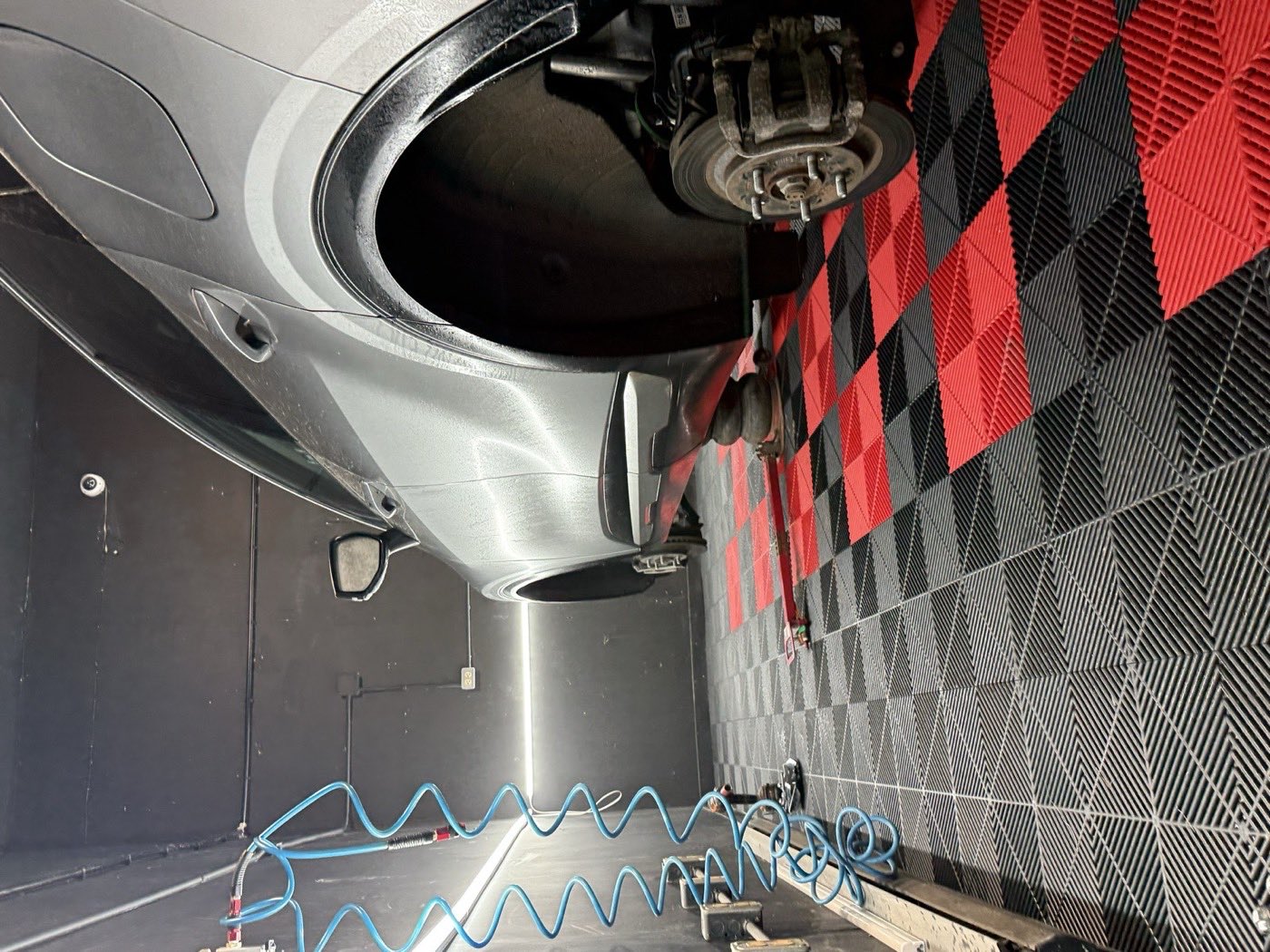
Lug nuts can lose clamping force in the first kilometres after a wheel is installed, as the wheel settles against the hub and the metal beds in. A re-torque at around 100 km catches that before it becomes a loose wheel. It takes minutes and it is free.
Every wheel we install is torqued to your vehicle's spec with a torque wrench, not an impact gun. The re-torque is not us fixing our own work. It is the check that confirms nothing moved once the wheel started carrying load.
Why do wheels need to be re-torqued?
When a wheel is first bolted up, the mating surfaces between wheel, hub, and nuts are not fully seated. Driving loads them, heats them, and settles them. As they bed in, the clamping force holding the wheel on can drop even though nothing was done wrong at installation.
What is actually happening
- Microscopic high spots on the mating faces flatten under load
- Any trace of rust, dirt, or paint between wheel and hub compresses
- Heat cycles from braking expand and contract the assembly
- The wheel pulls fully flush against the hub for the first time
The result is a joint that was correct at 120 Nm when it left the shop and may be reading lower after a hundred kilometres. Re-torquing brings it back to spec.
What happens if you do not re-torque your wheels?
Most of the time, nothing. That is why it gets skipped. But when it does go wrong, lug nuts back off, the wheel begins to wobble, the stud holes elongate, studs can shear, and in the worst case the wheel separates from the vehicle at speed.
While you're in for the re-torque, it's also a good moment to flag any slow leak: we can check it for repair.
Plenty of customers skip the re-torque. We know they do, because plenty never come back for it. Here is why we push it anyway: sometimes wheels do come off. It has happened to us, on our own vehicles, once or twice, where a wheel almost came off because we were busy and could not get in for a re-torque. So this is not a line we use to get people back through the door. If you skip it, you might end up stuck on the side of the road at the most inconvenient moment possible. Come back. It takes minutes.
The escalation, in order
- Clamping force drops below spec
- Nuts begin to loosen under load
- The wheel starts to move against the hub, and you may hear a click or a knock
- Stud holes elongate and the wheel is now damaged
- Studs shear, and the wheel comes off
Steps one and two are invisible and silent. By the time you can hear or feel it, you are already at step three and the wheel needs replacing, not just retorquing.
When should you get a re-torque?
At around 100 km of driving after any service where a wheel came off the vehicle. That includes a seasonal changeover, a rotation, a single tire replacement, and a tire repair. Sooner than 100 km is fine. Much later is where the risk sits.
The seasonal swap itself is booked the same way: see the booking page for a Fredericton winter tire swap.
We send an automatic reminder by text and email at roughly that mark, so you do not have to keep track of it yourself. If you have driven well past 100 km and never came in, still come in. Late is better than never.
Services that need a re-torque afterward
This is the same care that goes into every Fredericton tire change we book.
| Service | Re-torque needed |
|---|---|
| Seasonal changeover (off rims or on rims) | Yes |
| Tire rotation | Yes |
| Single tire replacement | Yes |
| Tire repair (wheel comes off) | Yes |
| Balancing where the wheel is removed | Yes |
| Adding air only | No |
What does a re-torque cost and how long does it take?
Nothing, and a few minutes. Drive in, we put a torque wrench on every nut on all four wheels and bring anything that has moved back to your vehicle's spec. No appointment, no charge, no upsell attached to it. It is the same free check we include after any changeover, rotation, or single tire replacement.
You do not need to book. Come by 300 Wilsey Road #1 in Fredericton any day we are open, Monday to Saturday 9 to 7 or Sunday 9 to 5. If you would rather call first, the number is (506) 248-6006.
Why we use a torque wrench, not an impact gun
An impact gun is fast and completely uncalibrated. Overtightening stretches studs and warps brake rotors. Undertightening leaves a wheel that will loosen. Every wheel we install is finished by hand with a torque wrench set to your vehicle's specification, in a star pattern, so the clamping load is even across all the nuts.
Key takeaways
- Wheels settle in the first kilometres of driving and clamping force can drop.
- Come back at around 100 km after any service where a wheel was removed.
- It is free, takes minutes, and needs no appointment.
- Skipping it is usually fine and occasionally very much not. The downside is a wheel coming off.
- We finish every wheel with a torque wrench to spec, never an impact gun alone.
- We send an automatic reminder, so you do not have to remember.
Frequently asked questions
Is a wheel re-torque really necessary? Yes. Clamping force can drop in the first kilometres after a wheel goes on, as the wheel seats against the hub and the mating surfaces bed in. A re-torque catches that. It takes a few minutes, and the alternative is a wheel that works loose on the highway.
When should I come back for a re-torque? At around 100 km of driving after your tire change. It does not have to be exact, and sooner is fine. We send an automatic reminder so you do not have to track it yourself. Just drop in, no appointment needed.
What happens if I skip the re-torque? Usually nothing, which is exactly why people skip it. But when it does go wrong, lug nuts loosen, the wheel starts to wobble, the stud holes elongate, and in the worst case the wheel comes off while you are driving. The odds are low and the consequence is severe.
How much does a re-torque cost? Nothing. It is part of the job. Drop in at 300 Wilsey Road #1 in Fredericton, we check every wheel and torque it to spec, and you are on your way. It takes minutes.
Frequently asked questions
Is a wheel re-torque really necessary?
Yes. Clamping force can drop in the first kilometres after a wheel goes on, as the wheel seats against the hub and the mating surfaces bed in. A re-torque catches that. It takes a few minutes, and the alternative is a wheel that works loose on the highway.
When should I come back for a re-torque?
At around 100 km of driving after your tire change. It does not have to be exact, and sooner is fine. We send an automatic reminder so you do not have to track it yourself. Just drop in, no appointment needed.
What happens if I skip the re-torque?
Usually nothing, which is exactly why people skip it. But when it does go wrong, lug nuts loosen, the wheel starts to wobble, the stud holes elongate, and in the worst case the wheel comes off while you are driving. The odds are low and the consequence is severe.
How much does a re-torque cost?
Nothing. It is part of the job. Drop in at 300 Wilsey Road #1 in Fredericton, we check every wheel and torque it to spec, and you are on your way. It takes minutes.
Book your visit at PitStop & Go
300 Wilsey Road #1, Fredericton, New Brunswick E3B 5J1 · (506) 248-6006