
What Causes Uneven Tire Wear?
Where a tire wears tells you why. Wear in the middle means over-inflation, wear on both edges means under-inflation, wear on one edge alone means alignment, and a patchy scalloped pattern means alignment too. Suspension and running the wrong tires for the season also cause it.
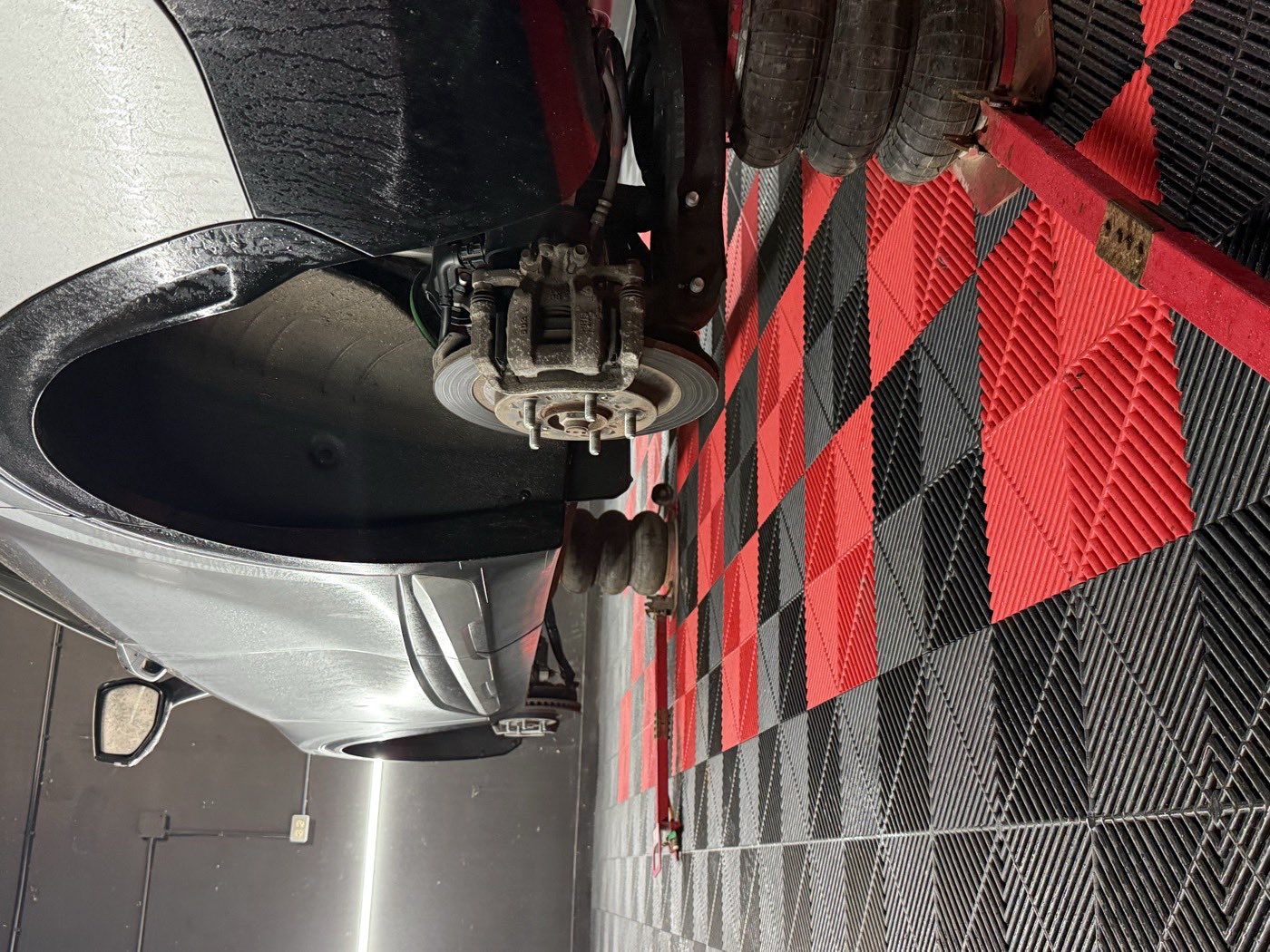
Where a tire wears tells you why. Wear in the middle means over-inflation, wear on both edges means under-inflation, wear on one edge alone means alignment, and a patchy scalloped pattern means alignment too. Suspension and running the wrong tires for the season also cause it.
If you are trying to work out whether you need an alignment or a balance, the wear pattern is where that answer comes from. The pattern is the diagnosis. Once you can read it, you can usually name the cause without any tools.
What do the different tire wear patterns mean?
Five common patterns, five different causes. Each one points somewhere specific, which is why looking at a tire tells you more than describing how the car feels. A tire cannot lie about what has been pulling on it, so learning to read the wear tells you the mechanical fault before it costs you the whole set.
Here is how we read them. If it is worn in the middle, the tire is over-inflated. If it is worn on the outside edges, it is under-inflated. If it is worn just on the inside of the tire, that is an alignment issue, camber. If it is worn just on the outside, also alignment, also camber. And if it is bumpy, eating away in a pattern around the tire, that is an alignment issue as well. Beyond that, uneven wear gets caused by suspension problems and by running the wrong tires for the season.
The decoder
| Pattern | Cause | Fix |
|---|---|---|
| Worn down the centre | Over-inflation | Set pressure to the door jamb spec |
| Worn on both outer edges | Under-inflation | Set pressure to the door jamb spec |
| Worn on the inside edge only | Alignment, camber | Alignment at a mechanic |
| Worn on the outside edge only | Alignment, camber | Alignment at a mechanic |
| Cupped, scalloped, patchy | Alignment, sometimes suspension | Alignment, and a suspension check |
| Worn faster on one axle | Normal for the drive wheels | Rotate on schedule |
Checking this before the seasonal swap is good practice too: see when to book the winter swap in Fredericton.
Why is the inside edge the one that catches people?
Because you cannot see it. The outer shoulder faces you when you walk up to the vehicle, and it can look completely healthy while the inner face is down to nothing. Drivers find out when the tire goes flat. That gap between what is visible and what is actually happening is exactly why this pattern goes unnoticed longest.
This is the one we bring up most. From the side a tire can look like it is still good, but when the alignment is not done properly there is more wear on the inside of the tire, and that is not visible. So put your hand on the tread on the inside of the tire and feel whether it is bald. We get people coming in with flat tires caused by exactly this, and they had no idea their tire was bad.
How to check it
- Turn the steering fully to one side so the front tire faces out
- Run your hand along the inner face of the tread
- Compare it to the outer face by feel
- Do the same on the other side, and reach behind the rears
If the inside is noticeably smoother or you can feel the wear bars, that tire is much closer to finished than it looks.
Does inflation really cause that much wear?
Yes, and it is the least expensive cause to fix. Over-inflation makes the centre of the tread carry the load and wear first. Under-inflation makes the shoulders carry it and wears both edges. Both waste a tire that had nothing else wrong with it.
The correct pressure is on the sticker inside your driver's door jamb, and there is more on that in what tire pressure your tires should be. The number moulded into the tire sidewall is that tire's maximum, not your target, and inflating to it over-inflates almost every vehicle on the road.
If the pattern points to a full replacement, Fredericton tire change costs are posted so you know the number going in.
Pressure also moves with temperature. Air contracts as it cools, so a set that was correct in October can be low by the first cold snap. Check pressures whenever the weather turns sharply.
Can uneven wear be fixed?
The cause can be fixed. The wear cannot. Rubber that has already gone does not come back, so a tire worn unevenly stays that way, and a badly worn edge can end a tire that still has good tread everywhere else.
If the wear turns out to be hiding a puncture rather than just an angle problem, that's worth a repair check too.
That is the real cost of ignoring it. A set that should have lasted years gets cut short by a fault that would have taken one visit to correct. Catching it early is the entire game.
What we can and cannot do
- We can read the wear, tell you the pattern, and tell you what it points at
- We can balance, rotate, set pressures, and replace tires
- We do not do alignments. That goes to a mechanic
- We do not do suspension work
We would rather send you to the right place than take money for a service that was never going to fix your problem.
How do you prevent it?
Check pressures monthly and before any temperature swing, rotate on schedule, feel the inside edges when you check, and get alignment looked at as soon as a pattern appears rather than after the tire is ruined. None of that takes special tools, just a few minutes of attention before a bad angle turns into an early replacement.
Our tire rotation is a posted flat rate per visit and usually takes 10 to 20 minutes. If you want the tread depths read and the wear patterns checked while the wheels are off, ask and we will do it as part of the visit.
Key takeaways
- Centre wear is over-inflation. Both edges is under-inflation.
- One edge alone, inside or outside, is an alignment camber issue.
- Cupped or scalloped wear is alignment, and sometimes suspension.
- The inside edge is invisible from the driveway. Check it by hand.
- Wrong tires for the season and worn suspension both cause uneven wear too.
- The cause is fixable. The wear already done is not.
Frequently asked questions
Why is my tire worn on the inside edge? That is an alignment angle, camber, pulling the tire onto its inner shoulder. It is the most commonly missed wear pattern because the inside face is invisible from where you park. Feel it by hand along the inner edge of the tread.
What does wear in the middle of the tire mean? Over-inflation. Too much pressure bulges the centre of the tread outward so it carries more of the load than the shoulders, and the middle wears out first. Set your pressure to the number on the door jamb sticker, not the maximum on the tire sidewall.
Can uneven wear be fixed? The cause can be fixed. The wear cannot. Rubber that is already gone does not come back, so a tire worn unevenly stays that way and often has to be replaced even though the rest of the tread looks fine. Catching it early is what saves the tire.
Does tire rotation prevent uneven wear? It prevents the normal front-to-rear difference, which is real on every vehicle. It does not fix alignment, inflation, or suspension problems. Rotation evens out expected wear. It does not cancel out a fault.
Frequently asked questions
Why is my tire worn on the inside edge?
That is an alignment angle, camber, pulling the tire onto its inner shoulder. It is the most commonly missed wear pattern because the inside face is invisible from where you park. Feel it by hand along the inner edge of the tread.
What does wear in the middle of the tire mean?
Over-inflation. Too much pressure bulges the centre of the tread outward so it carries more of the load than the shoulders, and the middle wears out first. Set your pressure to the number on the door jamb sticker, not the maximum on the tire sidewall.
Can uneven wear be fixed?
The cause can be fixed. The wear cannot. Rubber that is already gone does not come back, so a tire worn unevenly stays that way and often has to be replaced even though the rest of the tread looks fine. Catching it early is what saves the tire.
Does tire rotation prevent uneven wear?
It prevents the normal front-to-rear difference, which is real on every vehicle. It does not fix alignment, inflation, or suspension problems. Rotation evens out expected wear. It does not cancel out a fault.
Book your visit at PitStop & Go
300 Wilsey Road #1, Fredericton, New Brunswick E3B 5J1 · (506) 248-6006