
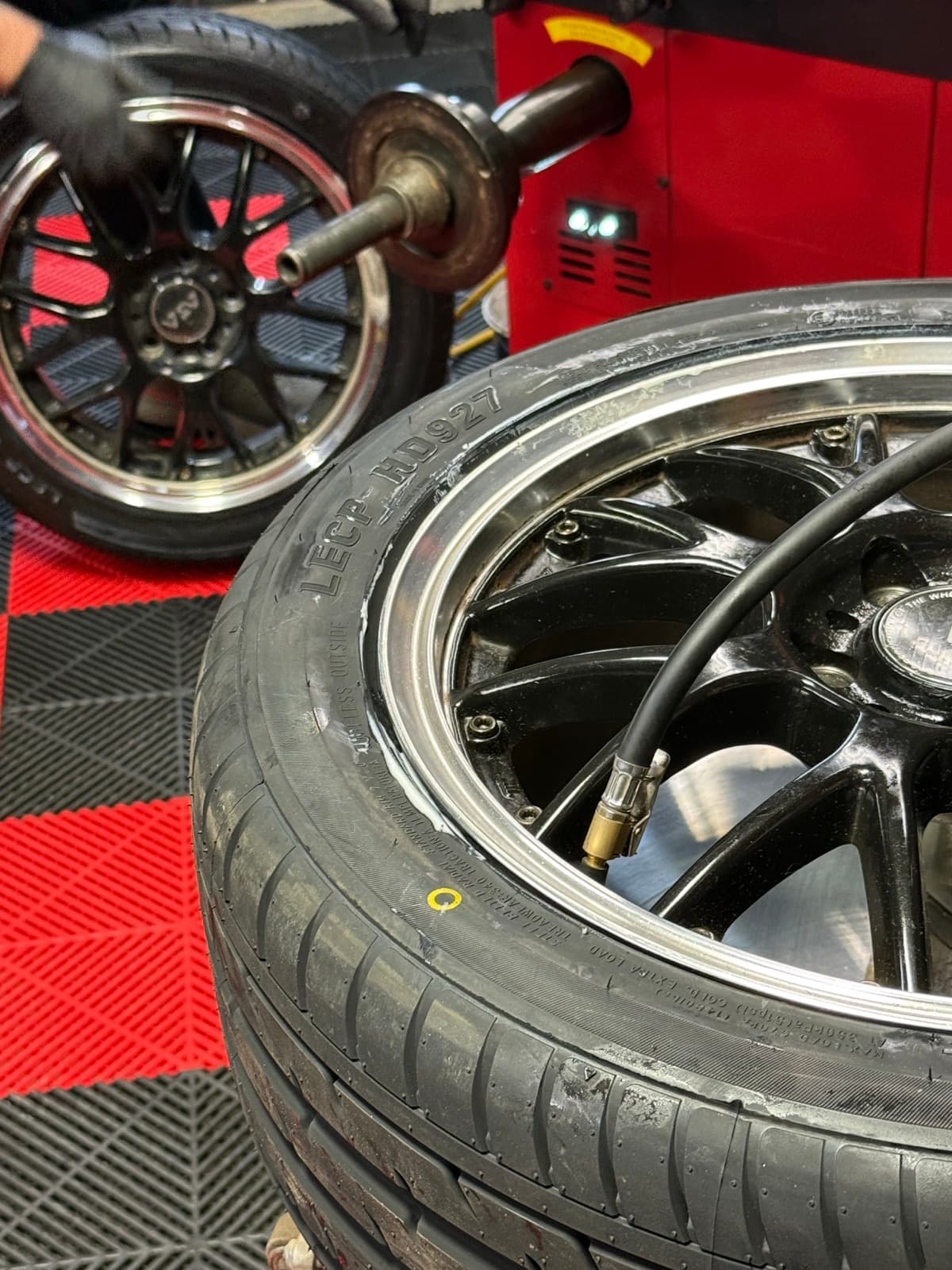
TPMS, Tire Pressure Monitoring System, is the electronics behind the low-pressure light on your dash. Most vehicles built after 2008 have it. Understanding how it works explains why your winter rims may need their own sensors and why the light sometimes needs a relearn after a tire service.
- TPMS warns you when a tire drops below a safe pressure.
- Direct TPMS uses a sensor inside each wheel; indirect uses ABS wheel-speed data.
- A second set of rims (winter) usually needs its own set of sensors.
- After some services the system needs a relearn to re-pair the sensors.
Direct vs indirect TPMS
Direct TPMS puts a battery-powered pressure sensor inside each wheel that radios its reading to the car. Indirect TPMS has no sensors: it infers a low tire from the ABS wheel-speed data, because an under-inflated tire rolls at a slightly different rate.
Direct systems are more precise and more common on newer vehicles; they are also why a second set of rims needs its own sensors. If you haven't booked the winter swap itself yet, the seasonal changeover guide for Fredericton covers timing and studded-tire rules alongside the sensor question.
Sensors, batteries, and relearns
TPMS sensors run on a sealed battery that typically lasts 5 to 10 years; when it dies the sensor is replaced. After mounting new tires or swapping rim sets, the system often needs a relearn so it knows which sensor sits where. We program and relearn as part of the install so you leave with the light off.
What a sensor costs, and when it actually needs replacing
TPMS sensor supply and install starts at $50 per sensor with balancing and installation included. Most vehicles take four, but you replace only the ones that have failed: one dead sensor does not mean buying a set of four, and any shop telling you otherwise is selling rather than diagnosing. If the sensor issue turns up while you're also due for the seasonal swap, Fredericton tire change pricing and scheduling covers both in one visit.
Sensors fail in two ordinary ways. The first is simply age: the internal battery is sealed and not separately replaceable, so somewhere between the five- and ten-year mark the sensor stops transmitting and is replaced as a unit. The second is physical: the sensor sits inside the wheel at the valve, so corrosion around the valve stem (road salt does this) or damage during a careless mounting can kill an otherwise healthy sensor.
That second cause is worth knowing about in a New Brunswick winter. Salt attacks the aluminium valve stems used on many sensors, and a stem that corrodes through will leak, which shows up as a tire that keeps going soft rather than as a warning light. Replacing the service kit, the grommet, nut and valve core, when tires are changed is cheap insurance and is part of a proper mount.
Cold mornings, low readings and false alarms
The single most common TPMS call we get in Fredericton is not a broken sensor. It's the first genuinely cold morning of the season, when half the city starts the car and finds the pressure light on.
This is physics rather than a fault. Air contracts as it cools, at roughly 1 PSI for every 5 to 6°C the temperature drops. A set of tires inflated correctly on a mild 15°C afternoon in October will genuinely be several PSI low at -10°C, and that is easily enough to cross the warning threshold, which is typically around 25% below the placard pressure.
So the light is telling the truth: the tires really are low, and they should be brought back to the pressure on the placard in the driver's door jamb. Two things follow from that. Set your pressures when the tires are cold, meaning before driving rather than after, because a warm tire reads high. And if the light comes back within a few days of a proper fill, you're no longer looking at temperature: that's a slow leak, and it's worth finding before it becomes a flat somewhere inconvenient. A repairable slow leak is usually a fast, inexpensive fix, and it's the more common cause than a failed sensor.
Is TPMS required by law in Canada?
No, and this surprises people, because the assumption is usually that it must be. There is no federal Canadian regulation requiring tire-pressure monitoring on passenger vehicles. In the United States it has been mandatory on new passenger vehicles since the 2008 model year, and because manufacturers build to a shared North American platform, most Canadian-market cars simply inherit the system.
Practically, that means a failed sensor is not the automatic inspection problem that a bald or damaged tire is. But we'd still fix it rather than live with it, for a reason that has nothing to do with regulation: a dash light that is permanently on is a warning you have trained yourself to ignore. The next time it comes on because a tire is genuinely going down, you won't see it.
Frequently asked
Do my winter rims need TPMS sensors?
If your vehicle uses direct TPMS (a sensor in each wheel) and you run a separate set of winter rims, yes: each rim needs its own sensor, or the warning light will stay on all winter. TPMS sensor install at PitStop & Go starts at $50 and includes balancing and installation.
What is a TPMS relearn?
A relearn re-pairs the sensors to your vehicle so it knows which sensor is on which corner. Some vehicles relearn automatically after a short drive; others need a tool. We handle the relearn as part of a tire service.
Can I just ignore the TPMS light?
We do not recommend it. The light means at least one tire is low, which hurts handling, fuel economy, and tire life, and can lead to a blowout. It also masks any future real warning. Get the pressure checked and the system reset.
How much does a TPMS sensor cost?
TPMS sensor supply and install at PitStop & Go starts at $50 per sensor, with balancing and installation included. Most vehicles use four. You only replace the ones that have failed: a dead sensor on one wheel doesn't mean replacing the whole set. Our full price list is published, so you can check the number before you come in.
Are TPMS sensors required by law in Canada?
No. Canada has no federal regulation requiring tire-pressure monitoring on passenger vehicles, which is different from the United States, where TPMS has been mandatory on new passenger vehicles since the 2008 model year. Most Canadian-market cars have it anyway because they share platforms with US-market models. What this means practically: a failed sensor is not an automatic safety-inspection failure in New Brunswick the way a bald tire is, but a permanently lit dash light is still masking a real warning you'd want to see.
How long do TPMS sensors last, and how do I know one has failed?
The sealed battery inside a direct TPMS sensor typically lasts 5 to 10 years, and it isn't separately replaceable: when the battery dies the sensor is replaced. The usual sign is a TPMS light that stays on, or flashes for 60–90 seconds at startup and then stays lit, even though all four tires are correctly inflated. A flashing-then-solid light generally indicates a system or sensor fault rather than low pressure; a steady light from cold start usually means a tire is genuinely low.
Why does my TPMS light come on when it gets cold?
Because air contracts as it cools: roughly 1 PSI for every 5–6°C drop. A tire set correctly on a mild October afternoon can genuinely read several PSI low on the first cold morning, which is enough to trip the sensor. That's a real low-pressure reading rather than a fault, and the fix is air. If the light returns within a few days of being reset, you likely have a slow leak worth looking at.
Related
Ready to roll out?
Book online in under two minutes, or call the shop and we'll find a slot today.