
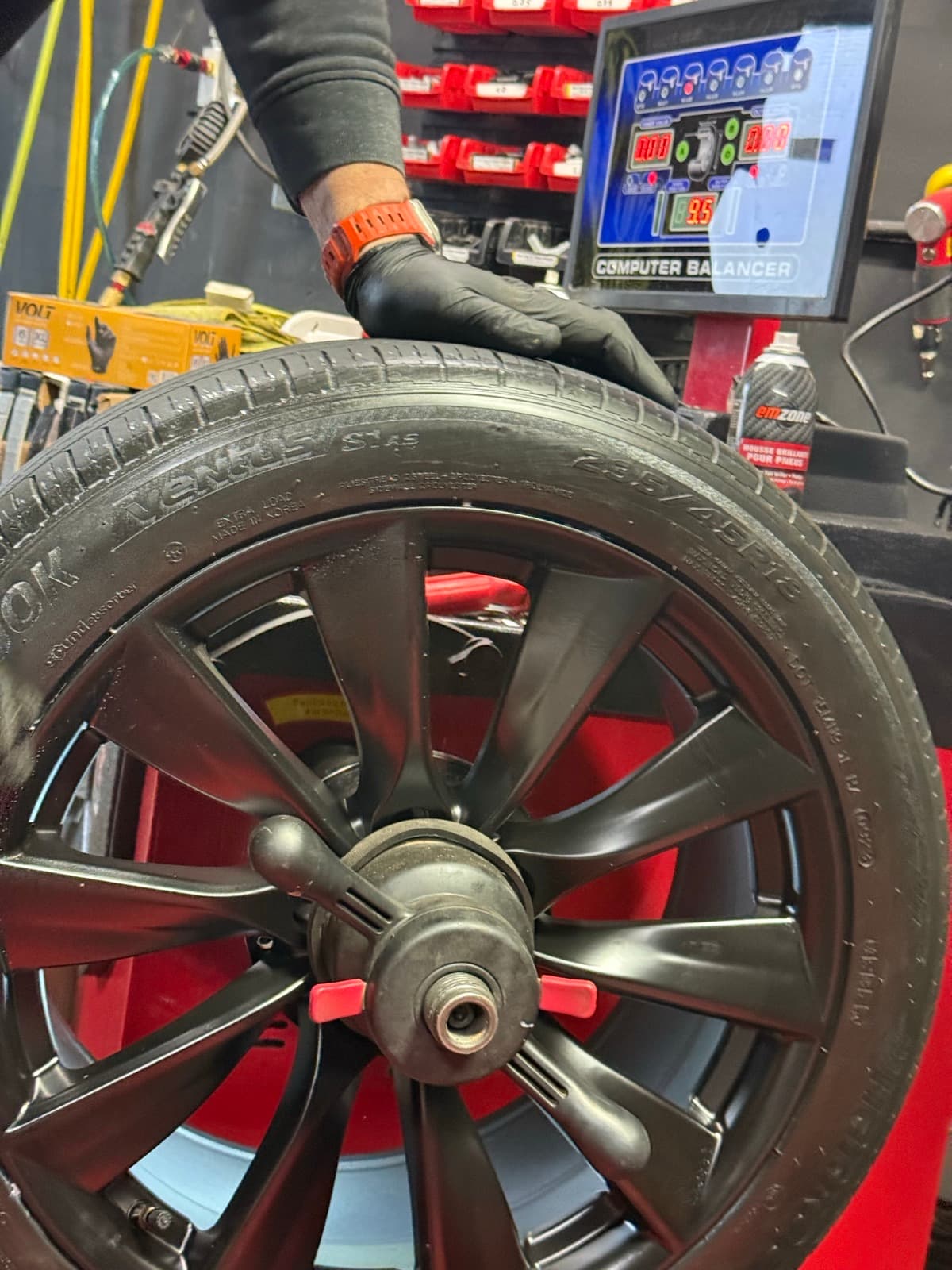
Whether a tire can be repaired comes down to where the damage is and how big it is. A puncture in the tread area, no more than 6 mm across, is a safe, inexpensive repair when it is done properly: the tire comes off the rim, gets inspected inside, and is sealed with a plug and a patch together. The shoulder and sidewall cannot be repaired at all, and a plug pushed in from the outside is not a repair on its own.
- The patch area is the tread: the band that meets the road. Punctures up to 6 mm there can be repaired.
- The shoulder and sidewall cannot be patched or plugged. Damage there means a new tire.
- A plug on its own, pushed in from outside, is not an acceptable repair. A proper repair is a plug and a patch, from inside.
- There is no set number of repairs, but repairs cannot overlap, and the tire maker can set its own limits.
- A tire that already carries an improper repair has to be replaced, not repaired again.
- We use an internal patch, the only industry-approved repair, with a leak-proof guarantee.
The tire patch area
Picture the tread split into three: a central repairable band and the two shoulders. The band that meets the road is the patch area. It sits over the steel belts and barely flexes, so a proper repair there holds for the rest of the tire's working life. A puncture in that band, no more than 6 mm across, with no sidewall involvement and no earlier repair in the way, is a textbook repair. Roughly 70% of the flats we see qualify. That's the same standard our tire repair service uses on every patch we do.
The size limit is 6 mm, about a quarter of an inch. A roofing nail or a screw is almost always inside it. A slice, a tear or a hole you can see daylight through is not.
What part of a tire cannot be patched?
The sidewall and the shoulder. The shoulder is the rounded edge where the tread turns down into the sidewall. The industry procedure is plain about it: no repairs where the damage reaches the shoulder or belt edge, and none where the puncture goes in at an angle that carries it into the shoulder. If there is any doubt about whether it reaches the shoulder, the tire comes out of service.
Bead damage, where the tire seals against the rim, is not repairable either, and neither is a tire that has been driven on flat long enough to damage the inside.
When can a tire not be plugged?
A plug on its own is not a repair. The published procedure calls a plug alone an unacceptable repair: a proper one fills the hole with a rubber stem, the plug, and seals the inside liner with a patch, usually as one combined unit. That can only be done with the tire off the rim, which is also the only way to see damage on the inside.
So a tire cannot be plugged, or repaired any other way, when the puncture is outside the tread area, bigger than 6 mm, would overlap an earlier repair, or sits in a tire that already carries an improper repair. That last one catches people out: a tire with an old plug pushed in from the outside has to be replaced, not repaired again.
Is it safe to patch a tire on the sidewall?
No. The sidewall flexes on every rotation and carries the weight of the car. A patch there cannot hold, and when it lets go it can do so at highway speed. A puncture, cut or bulge in the sidewall means a new tire, every time.
When it's a replacement, Fredericton tire change costs and options are published so you're not guessing at the counter.
How many times can you plug or patch a tire?
The industry procedure does not give a number. It gives two rules: repairs cannot overlap, and specific limits come from the tire maker, which can restrict repairs on some tires such as run-flats. In practice that means a tire can take a second repair if the new puncture is in the tread area and clear of the first one.
What decides it is the inspection. With the tire off the rim we can see whether the new damage is clear of the old repair and whether the inside is still sound. If it is, we repair it. If not, we tell you, and show you why.
If a flat catches you right before you were going to swap seasons anyway, check whether it's time for the winter switch in Fredericton.
Frequently asked
When can a tire not be plugged?
When the damage is in the shoulder or sidewall, when the hole is bigger than 6 mm across, when it would overlap an earlier repair, when the tire has been driven on flat and damaged inside, or when it already carries an improper repair such as an outside plug on its own. In each case the tire has to be replaced. And a plug alone is never the whole repair: the industry procedure is a plug to fill the hole plus a patch to seal the inside.
What part of a tire cannot be patched?
The sidewall and the shoulder, the curved edge where the tread meets the sidewall. Only the tread area can be repaired. If a puncture runs into the shoulder or belt edge, or enters the tread at an angle that carries it into the shoulder, the tire must come out of service.
Is it safe to patch a tire on the sidewall?
No. The sidewall flexes on every rotation and carries the load, so a patch there cannot hold and can fail at speed. A sidewall puncture, cut or bulge means a new tire. We will show you where the damage sits before you spend anything.
How many times can you plug a tire?
There is no fixed number in the industry procedure. What it does say is that repairs cannot overlap, that every repair must be a plug and a patch done from inside the dismounted tire, and that the tire maker may set its own limits for some tires, run-flats for example. So a tire can take more than one repair if each puncture sits in the tread area, apart from the others. A tire with an old outside-only plug has to be replaced rather than repaired again.
What is the tire patch area?
The tread area, the band of the tire that meets the road. It is backed by the steel belts and barely flexes, which is why a repair there holds. The shoulder and sidewall flex constantly, so they sit outside the patch area.
Can a nail in my tire be repaired?
Usually yes, if it is in the tread area, no more than 6 mm across, and the tire has not been driven on flat. We remove the nail, inspect from the inside, and apply an internal patch. Repairs start at $45 and take about 15 to 20 minutes.
How much does it cost to patch or vulcanize a tire?
An interior patch repair is $45 on a small or midsize car and $55 on a pickup or large SUV, flat per job, however long it takes us, with a leak-proof guarantee. Set against the price of a new tire it is almost always the cheaper call, provided the puncture is in the repairable area.
Are plug repairs safe?
An external plug alone is a temporary fix, not a proper repair. The industry-approved method is an internal patch (or a combination patch-plug) installed from inside the dismounted tire, where the technician can inspect for hidden damage. That is what we use.
Related
Ready to roll out?
Book online in under two minutes, or call the shop and we'll find a slot today.